Analytics: Predictive, Descriptive, Prescriptive Differences
Posted on: 2026-07-15
By: Avery Jordan
In today's data-driven landscape, understanding how to leverage analytics is not just advantageous—it's essential. Analytics isn't merely about numbers; it's about transforming raw data into actionable insights that can drive your business forward.
What You Will Learn
- Descriptive analytics provides historical insights that help businesses assess past performance and trends.
- Predictive analytics utilizes historical data to forecast future trends, allowing organizations to make proactive decisions.
- Prescriptive analytics recommends specific actions based on data insights, guiding strategic decision-making.
- Understanding the core differences between descriptive, predictive, and prescriptive analytics is key for effective data-driven strategies.
- Implementing the right analytics type aligned with business goals maximizes data value and supports informed decision-making.
The Three Pillars of Analytics: A Comparative Overview
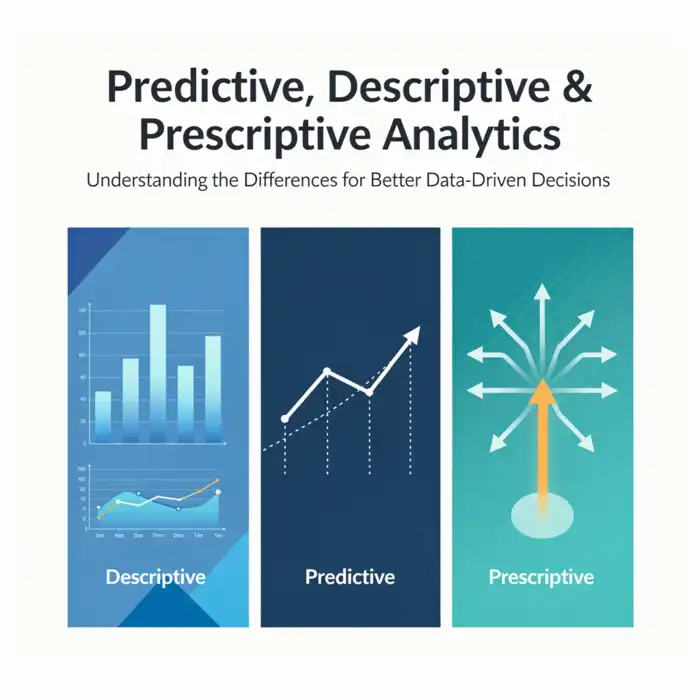
Each type of analytics—descriptive, predictive, and prescriptive—serves a distinct purpose, yet together they form a powerful framework for data-driven decision-making. Below is a comparison of their core focus areas, key questions, and essential tools.
Descriptive Analytics
**Focus:** What happened?
- What were our sales last quarter?
- Which products were most popular?
Predictive Analytics
**Focus:** What could happen?
- Likely sales forecasts for next quarter?
- Which customers are at risk of churn?
Prescriptive Analytics
**Focus:** What should we do?
- What actions should we take?
- How to optimize business strategies?
Understanding the Analytics Landscape: Definitions and Goals
Analytics is a vast field that can sometimes feel overwhelming. At Analytics Ltd, we believe that understanding the different types of analytics is crucial for any business looking to leverage data effectively. This section will break down the key types of analytics, including descriptive, predictive, and prescriptive analytics, and help you grasp their definitions and goals.
When we talk about analytics, we’re essentially discussing how to turn raw data into actionable insights. Whether it’s understanding past trends or forecasting future outcomes, each type of analytics plays a distinct role in guiding business decisions. Let’s dive into the specifics!
What is Descriptive Analytics and Its Role?
Descriptive analytics is like looking in the rearview mirror; it helps you understand what has happened in your business. By analyzing historical data, descriptive analytics provides insights into past performance and trends, enabling businesses to identify patterns and make informed decisions moving forward.
- Identifying trends over time
- Understanding customer behavior
- Assessing the effectiveness of marketing campaigns
These insights are essential for any organization, as they help establish a foundation upon which further analytics can be built. At Analytics Ltd, we frequently use descriptive analytics to help our clients understand their current performance and identify areas for growth, which often involves understanding data visualization basics.
Key Questions Answered by Descriptive Analytics
Descriptive analytics can answer several key questions that form the basis of business intelligence:
- What were our sales last quarter?
- How many customers visited our website last month?
- Which products were the most popular among consumers?
By tackling these questions, businesses can gain a clearer picture of their operations and market standing.
Common Tools and Techniques Used in Descriptive Analytics
There are various tools and techniques that facilitate descriptive analytics. Commonly used tools include:
- Tableau: For data visualization
- Excel: For basic data analysis and reporting
- Google Analytics: For website traffic analysis
Each of these tools allows businesses to present their data in a way that is easy to understand, ultimately enabling better decision-making.
Understanding Descriptive Statistics and Its Importance in Data Analytics
Descriptive statistics forms the backbone of descriptive analytics. It involves summarizing and organizing data in a meaningful way. Key concepts include measures of central tendency (mean, median, mode) and measures of variability (range, variance, standard deviation).

These statistics are vital because they help us summarize large datasets into understandable metrics, making it easier for organizations to draw insights and act upon them. Without a solid grasp of descriptive statistics, you might find it challenging to interpret your data effectively.
Exploring Predictive Analytics: Forecasting Future Outcomes
While descriptive analytics focuses on the past, predictive analytics looks forward. It utilizes historical data to predict future events, helping businesses make proactive decisions. This type of analytics is increasingly important in today's fast-paced market.
At Analytics Ltd, we leverage predictive analytics to help our clients anticipate customer needs and market trends. This forward-thinking approach allows organizations to stay ahead of the competition!
What Questions Does Predictive Analytics Address?
Predictive analytics helps answer critical questions such as:
- What are the likely sales forecasts for next quarter?
- Which customers are at risk of churn?
- What products will be in high demand next season?
Answering these questions allows businesses to strategize better and allocate resources effectively.
Essential Techniques and Technologies in Predictive Analytics
Many techniques and technologies underpin predictive analytics, including:
- Regression Analysis: To model relationships between variables
- Time Series Analysis: To analyze data points collected or recorded at specific time intervals
- Machine Learning Algorithms: To improve prediction accuracy over time
These methods enhance the reliability of predictions and support data-driven decision-making.
The Role of Machine Learning in Predictive Modeling
Machine learning is a game-changer in predictive analytics. It enables systems to learn from data patterns and improve their predictions without explicit programming. This capability allows businesses to refine their models continuously, resulting in more accurate forecasts.
As a result, organizations can respond more swiftly to market changes, positioning themselves for success in a competitive landscape.
Prescriptive Analytics: Guiding Decision-Making Actions
Prescriptive analytics takes the capabilities of descriptive and predictive analytics to the next level by recommending actions based on data insights. It’s about not just understanding what’s happening or what is likely to happen, but also determining what should be done.
At Analytics Ltd, we emphasize the importance of prescriptive analytics in strategic planning. It helps businesses navigate complex decisions and optimize their operations effectively!
Understanding the Purpose of Prescriptive Analytics
The primary goal of prescriptive analytics is to answer the question: “What should we do?” It provides organizations with actionable insights that guide them in decision-making processes, ensuring they can capitalize on opportunities and mitigate risks.
Methods and Tools for Effective Prescriptive Analytics
Several methods and tools can enhance prescriptive analytics, including:
- Optimization Techniques: To find the best possible outcomes
- Simulation Models: To assess different scenarios
- Decision Trees: To visualize possible outcomes based on choices
These tools empower organizations to make informed decisions that align with their strategic goals.
Optimizing Business Strategies with What-If Analysis and Scenario Planning
What-if analysis and scenario planning are essential components of prescriptive analytics. They allow businesses to explore various possibilities and outcomes based on different variables. This capability helps organizations prepare for uncertainties by modeling potential future scenarios.
By embracing these practices, businesses can optimize their strategies and navigate complex challenges more effectively!
Comparing the Three Analytics Types: Key Differences and Similarities
Understanding the differences and similarities between descriptive, predictive, and prescriptive analytics is crucial for effective data-driven decision-making. Each type serves a unique purpose but together they form a comprehensive analytics framework that empowers businesses to thrive.
Comparison Table: Core Differences Between Analytics Types
| Analytics Type | Focus | Key Questions | Tools |
|---|---|---|---|
| Descriptive | What happened? | What are the trends? | Tableau, Excel, Google Analytics |
| Predictive | What could happen? | What are future trends? | Regression Analysis, Machine Learning |
| Prescriptive | What should we do? | What actions should we take? | Optimization Tools, Decision Trees |
This comparison highlights how each analytics type contributes to the overall understanding of data, helping businesses make informed decisions.
When to Use Each Analytics Type Based on Business Goals
Choosing the right analytics type depends on your specific business goals. Here’s a quick guide:
- Use descriptive analytics to assess past performance.
- Use predictive analytics to forecast future trends.
- Use prescriptive analytics to guide strategic decision-making.
By aligning your analytics efforts with your business objectives, you can maximize the value derived from your data.
Utilizing Key Performance Indicators (KPIs) to Measure Analytics Effectiveness
Key Performance Indicators (KPIs) are crucial for measuring the effectiveness of your analytics initiatives. By tracking the right KPIs, businesses can evaluate the impact of their analytics strategies and make adjustments as needed. Some common KPIs to consider include:
- Return on Investment (ROI)
- Customer Acquisition Cost (CAC)
- Conversion Rate

Monitoring these indicators will help you gauge the success of your analytics efforts and ensure alignment with your strategic goals.
Pro Tip
To maximize the effectiveness of your analytics efforts, consider integrating all three types—descriptive, predictive, and prescriptive—into a cohesive strategy. This multi-faceted approach not only enhances your understanding of past performance but also prepares you for future challenges while providing actionable insights for immediate decision-making.
Key Takeaways on the Differences Between Analytics Types
As we navigate the landscape of analytics, it's essential to recognize the distinct roles each type plays in driving business decisions. Descriptive analytics focuses on understanding what has happened, providing historical insights that inform current strategies. Predictive analytics, on the other hand, allows businesses to forecast future outcomes based on past data, giving them a competitive edge in planning. Finally, prescriptive analytics goes a step further by recommending actionable strategies to optimize business performance and decision-making processes.
To help clarify these differences, here’s a summary of each type:
- Descriptive Analytics: Answers the question “What happened?” by summarizing historical data.
- Predictive Analytics: Focuses on “What is likely to happen?” utilizing statistical models and machine learning.
- Prescriptive Analytics: Addresses “What should we do about it?” by recommending actions based on data insights.
Understanding these core distinctions can empower businesses to choose the right analytics strategy that aligns with their goals.
Recommended Next Steps for Businesses Interested in Analytics
For organizations eager to harness the power of analytics, there are several actionable steps to consider. First, it’s crucial to assess your current data infrastructure and identify areas for improvement. Investing in the right tools and technologies is vital. Here are some recommended steps:
- Conduct a data audit to understand the quality and availability of your current data.
- Define clear objectives for what you want to achieve with analytics.
- Invest in training your team on the different types of analytics and their applications.
- Start with pilot projects using descriptive analytics to build a foundation before moving to more complex predictive and prescriptive analytics.
By taking these steps, businesses can start to build a robust analytics framework that leads to more informed decision-making and enhanced performance.
Engaging with Analytics: How to Choose the Right Type for Your Needs
Decision-Making Framework Based on Business Context
Choosing the right type of analytics hinges on understanding your specific business context and objectives. Each type of analytics serves different needs, which makes it essential to align your analytics strategy with your business goals. Ask yourself:
- What problem are we trying to solve?
- What decisions need to be supported by data?
- How mature is our existing data infrastructure?
This framework will help you determine whether you need descriptive, predictive, or prescriptive analytics. At Analytics Ltd, we often advise our clients to start with descriptive analytics to gain insights before progressing to predictive and prescriptive approaches.
Resources for Further Learning and Implementation Support
To deepen your understanding and implementation of analytics, various resources are available. Here are some valuable options:
- Online Courses: Platforms like Coursera and edX offer courses on data analytics that cover all three types.
- Books: Titles such as "Analytics for Dummies" provide foundational knowledge.
- Webinars and Workshops: Join industry-specific sessions hosted by analytics firms and professionals to stay updated.
Additionally, connecting with analytics communities can provide ongoing support and knowledge sharing.
Understanding the Role of Data Science and Big Data in Modern Analytics
As we look to the future, data science and big data will play an increasingly crucial role in analytics. The ability to process vast amounts of data allows businesses to uncover deeper insights and trends. Incorporating machine learning and AI into your analytics strategy will not only enhance predictive capabilities but also improve decision-making efficiency. At Analytics Ltd, we’re committed to staying at the forefront of these advancements, ensuring our clients benefit from the latest innovations in data analytics.
Frequently Asked Questions About Analytics Types
What is the primary difference between descriptive, predictive, and prescriptive analytics?
Descriptive analytics tells you "what happened" by summarizing historical data. Predictive analytics forecasts "what could happen" using historical patterns. Prescriptive analytics recommends "what should we do" to achieve the best outcome.
Which type of analytics should a new business start with?
New businesses typically start with descriptive analytics to understand their past performance and current trends. This builds a foundational understanding before moving to more complex predictive and prescriptive approaches.
What tools are commonly used for descriptive analytics?
Common tools for descriptive analytics include Tableau for data visualization, Excel for basic data analysis and reporting, and Google Analytics for website traffic analysis.
How does machine learning contribute to predictive analytics?
Machine learning algorithms enable predictive analytics systems to learn from data patterns and continuously improve the accuracy of their forecasts without explicit programming, allowing for more precise future outcome predictions.
Can prescriptive analytics truly optimize business strategies?
Yes, prescriptive analytics uses techniques like optimization and simulation to recommend specific actions. By modeling different scenarios and their potential outcomes, it helps businesses make informed decisions to optimize strategies and mitigate risks.
Recap of Key Points
Here is a quick recap of the important points discussed in the article:
- Descriptive Analytics: Focuses on understanding historical data to identify trends and patterns, answering questions like "What happened?"
- Predictive Analytics: Utilizes historical data to forecast future outcomes, helping businesses anticipate trends and customer needs.
- Prescriptive Analytics: Recommends actions based on data insights, guiding decision-making and strategic planning.
- Key Tools: Common tools for analytics include Tableau, Excel, and Google Analytics for descriptive analytics; regression analysis and machine learning algorithms for predictive analytics.
- Actionable Steps: Conduct a data audit, define clear objectives, invest in team training, and start with descriptive analytics to build a solid foundation.
 In today's digital landscape, understanding the value of your customers is more crucial than ever. C
 In today's fast-paced digital landscape, effective event tracking isn't just an option—it's a
 Effective data governance is more than just a buzzword; it's a critical strategy that can determine